
Equestrian Technology
What Happens When a Dressage Schedule Meets Reality
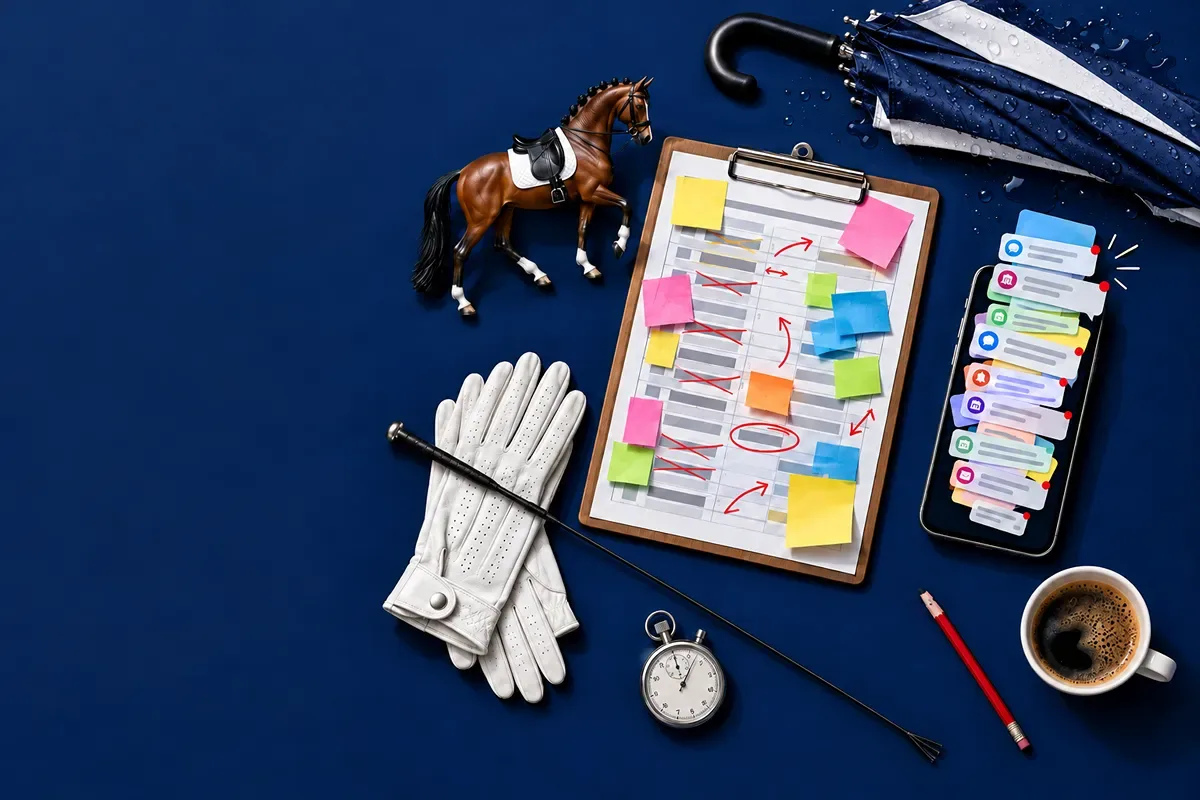
Every dressage schedule is perfect until the exhibitors see it.
Ride times line up in neat intervals. Judges have their breaks. Riders with several horses have room between rides. The schedule goes out by email and on Facebook, and for a few hours it looks like it's going to be an easy day.
Then the first change request comes in by email. Then another on Facebook Messenger. Then a text. Then a call. Oh, and the forecast now says rain. Hard rain. So we'll be moving arenas around. Yikes!
The schedule is a living document
People outside the show office tend to think of a schedule as something you build once and publish. Inside the office, you know it's a living document from the moment it exists.
A typical show day brings some mix of:
- Scratches. A horse turns up sore. A rider gets called in to work at the last minute. Each scratch leaves a hole, and the office has to decide whether to leave it or get the word out fast enough to fill it.
- Late entries and additions. Someone wants to add a test. Someone else wants to move up a level. On the day of the show. Usually the answer is a regretful no, even though we'd really love to say yes.
- Rider conflicts. Sure, you planned for those. What you didn't plan for is discovering that the "rider" on the entry is actually the owner, and the person really riding is on another horse in the slot just before or after. (Ask me how I know. It has happened. More than once.)
- Ring and judge changes. A judge's flight is late. The judge's contract has the wrong date on it. The rain turns out to be harder than forecast, and the ring isn't just wet, it's under six inches of water. A whole block of rides has to move.
- Requests. "Can I ride earlier? I have a long drive home." Multiply that by a few dozen exhibitors.
None of this is unusual. That's the point. A schedule that only works when nothing changes isn't really a schedule. It's a draft.
Where spreadsheets start to struggle
Plenty of shows run on spreadsheets, and plenty of capable secretaries make them work. I have a lot of respect for that. But in a show office, a spreadsheet has two big weaknesses: it usually lives on one person's computer, and it has no idea what else is happening that day.
A spreadsheet doesn't know that the rider in row 14 is also in row 37, and that moving one ride breaks the gap the other depends on. It can't tell everyone that a coveted early slot just opened up because of a scratch.
Scoring has its own weak spots. Whether the totals are added on an adding machine or typed into a spreadsheet, nothing double-checks the person doing it. It's easier than you'd think to make the same mistake twice in a row, especially with the coefficients.
That's not a people problem. It's a tool problem.
What I wanted the software to do
Dressage Scheduler Pro came straight out of those show-office moments. Instead of building a general event tool and bending it to fit dressage, I started from how a dressage show office actually works.
A few principles shaped it:
The rules should live in the system, not in someone's head. Rider spacing, test times, ring assignments, and judge breaks are things the software should track and enforce. When something moves, the system should flag the conflicts it creates.
Changes should be easy, not scary. Scratches and swaps happen all day. Making one should take seconds, and you should be able to see exactly what it affects before you commit.
Scheduling and scoring belong together. Once rides start, the schedule turns into results. Keeping ride times, scores, coefficients, placings, and published results in one connected place means less retyping and less hand math, which is where mistakes creep in.
Exhibitors need current information. A schedule posted on the office window at 7 a.m. is out of date by 8. Ride times and results that update throughout the day save a lot of trips to the office, and a lot of messages.
Stay focused. Dressage Scheduler Pro doesn't try to be the whole show office. It focuses on the dressage ring, meaning scheduling and scoring, and works alongside the tools a show already uses for entries and paperwork.
What the show office taught me about software
Building this tool reinforced a few things I believe about software for any business:
- Build from real workflows. The best features came from watching what people actually do under pressure, not from a feature list.
- Plan for the exceptions. The normal case is easy. The value is in handling the scratch, the conflict, and the flooded arena gracefully.
- Respect the people using it. Show secretaries and volunteers are skilled and busy. Software should make their judgment easier to apply, not try to replace it.
Where it's headed
Dressage Scheduler Pro is in beta now, tested by seasoned show secretaries at real shows. Every show teaches me something new about the gap between the schedule on paper and the schedule on the ground.
If you run a dressage show, or you're the person who keeps one running, I'd love to hear what your show day looks like and where the friction is.
Interested in Dressage Scheduler Pro? It's built for dressage show organizers and secretaries who want scheduling and scoring that hold up on show day. Get in touch to learn more or ask about joining the beta.